 English
 Español
 中文简体
中文简体 русский
Chinese Custom Brass Padlocks: Types, Materials, and Care
Types of Chinese Custom Brass Padlocks
Chinese custom brass padlocks are manufactured primarily in the Zhejiang, Guangdong, and Shandong provinces. They are exported worldwide and are known for offering a range of quality levels, from inexpensive decorative locks to more durable security models. "Custom" refers to keying options (keyed alike, keyed different, master keyed), engraved logos, special shackle lengths, or specific finishes (polished, antique, or coated). The following types are distinguished by body construction, cylinder type, and intended application.
Cast brass padlock (sand casting or die casting). The body is made by pouring molten brass (often C83600 or C85800, with 80–85% copper, 3–5% lead for machinability) into a mold. Sand-cast locks have a slightly rough surface texture; die-cast locks are smoother. Cast brass is less expensive than forged brass. Used for luggage, lockers, cabinets, and low-security gates. The brass may contain 1–2% lead (to improve casting flow). These locks are often painted or clear-coated to prevent tarnish. Weight: 50–150 g. Security level: low (picking resistance 1–2 minutes). They are often sold in keyed-alike sets of 4, 6, or 12.
Forged brass padlock (solid brass, hot forged). The body is formed from a hot brass billet (C37700 or C36000) under high pressure (500–2,000 tonnes). Forged brass is denser and stronger than cast brass. The surface is smooth and has no porosity. Forged locks are heavier (100–300 g for a 40 mm body) and more durable. They are used for gates, sheds, hasps, and commercial applications. The cylinder is often a 5-pin or 6-pin tumbler (solid brass pins). Security level: moderate (picking resistance 5–10 minutes) if the cylinder has spool or serrated pins. Many forged locks are stamped "FORGED" on the underside of the body.
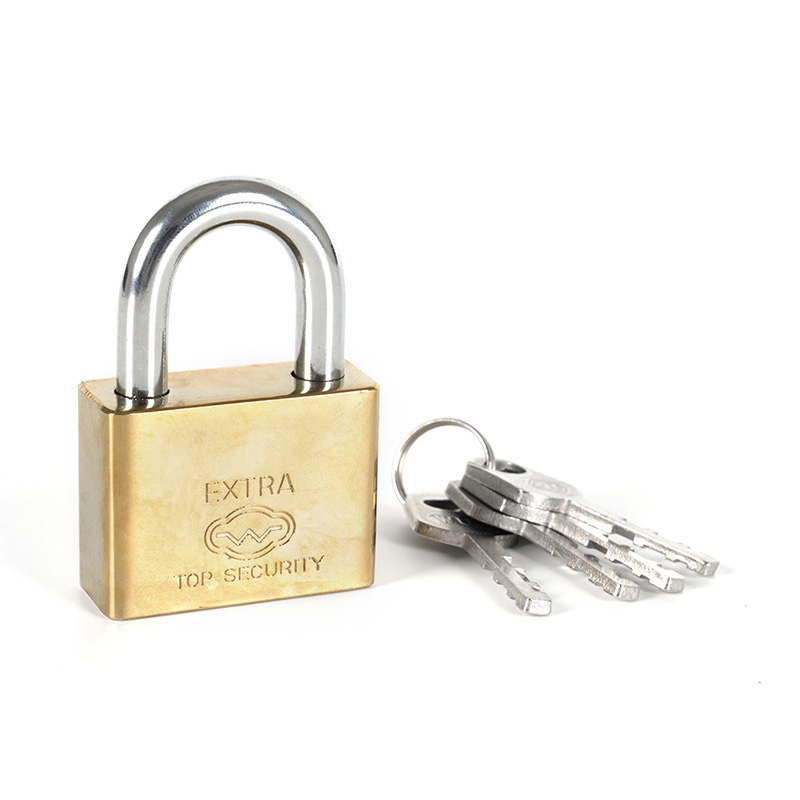
Brass body with steel shackle (composite). The lock body is brass (cast or forged), but the shackle (the U-shaped loop) is made of hardened steel (45–50 HRC). The steel shackle resists cutting with bolt cutters better than a brass shackle (brass is soft, can be cut with 18-inch bolt cutters in 2–3 seconds). The steel shackle is often chrome-plated or zinc-plated to prevent rust. These are the most common "Chinese custom brass padlocks" for outdoor use (gates, storage units). The steel shackle is vulnerable to rust at the point where it enters the body; the plating wears off after 1–2 years. Security level: moderate to high for the shackle, but the brass body is still vulnerable to drilling. Weight: 150–400 g.
Long-shackle brass padlock (extra shackle clearance). The shackle is 50–120 mm tall (instead of the standard 20–30 mm). Used for chain link fences, hasps with tall staples, or securing multiple items (motorcycle disk brake locks). The long shackle is easier to cut (longer lever arm) – a 12 mm thick long shackle can be cut with a 24-inch bolt cutter in 10–15 seconds; a standard shackle takes 5–8 seconds. The brass body is standard. Custom shackle lengths are a common request ("custom" aspect). Shackle diameter is often 8–12 mm.
Material Details of the Chinese Custom Brass Padlock
Brass Alloys – C36000, C37700, and C83600. The vast majority of Chinese brass padlocks use one of three common alloys. C36000 (free-machining brass) contains 61.5% copper, 35.5% zinc, and 3% lead. The lead content (2.5–3.7%) makes the brass easy to machine (cut on CNC lathes), which is why it is used for cylinders, pins, and key blanks. However, C36000 is not as corrosion-resistant as lower-lead alloys; in salt water, leaded brass dezincifies faster (the lead leaves a porous structure). C37700 (forging brass) has 58–62% copper, 38–42% zinc, and 1.5–2.5% lead. It is used for forged bodies. C85800 (die-casting brass) has 57–61% copper, 0.5–1.5% aluminum, and 0.5–1.5% lead. It is a cheap alloy for cast bodies; the aluminum content improves fluidity in casting. Some Chinese manufacturers use "brass-plated steel" – a steel core with a thin brass layer (0.1–0.3 mm) electroplated onto it. These are not genuine brass padlocks. How to test: file a small notch in an inconspicuous area (the bottom). A genuine brass lock shows yellowish metal (brass) throughout; a plated lock shows silver or gray steel under the thin brass layer.
Cylinder and Pin Materials. The cylinder (the removable core that the key enters) is made from C36000 brass (for machinability). The bottom pins (the ones that contact the key) are also brass. The driver pins (the ones that sit above the bottom pins) are often made of nickel-silver (a copper-nickel-zinc alloy, 60% Cu, 20% Ni, 20% Zn). The springs that push the pins down are stainless steel (302 or 304) or plated music wire. In cheap padlocks, the springs are ordinary steel wire and can corrode in wet environments, causing the lock to jam. The plug (the part that rotates) is brass; the shell (the outer cylinder casing) is also brass. The plug has a stop pin (a brass or steel piece) that prevents the plug from rotating more than 90 degrees.
Shackle Materials (Brass vs. Steel). A "brass padlock" may have a brass shackle or a steel shackle (chrome-plated). Brass shackles are made from the same alloy as the body (C36000 or C37700). They are soft (hardness 80–100 HV). A 10 mm brass shackle can be cut with 18-inch bolt cutters in 1–2 seconds. Steel shackles are made of medium-carbon steel (1045 or 1060, hardness 45–50 HRC after heat treatment) or case-hardened steel (surface hardness 55–60 HRC, core hardness 30–40 HRC). A 10 mm hardened steel shackle resists bolt cutters for 10–30 seconds, and resists a hacksaw (18 TPI blade) for 2–4 minutes. The steel shackle is inserted into the brass body; the body has brass or steel ball bearings that lock the shackle. The weak point is not the shackle but the point where the shackle enters the body: a sharp blow with a hammer can shear the brass body around the shackle hole. For security, choose a steel shackle with a body that has a steel "shroud" (a steel plate over the brass around the shackle holes).
Chinese Custom Brass Padlocks: Types, Materials, and Care
High Security Padlock Factory
Copyright © Zhejiang Pujang Wushi Locks Co., Ltd. All Rights Reserved.
