 English
 Español
 中文简体
中文简体 русский
Powder-Coated Door Padlocks: Does Finish Add Protection
The finish on a padlock is easy to treat as a visual detail, yet it can influence how the lock body handles moisture, abrasion, and everyday outdoor exposure. A Powder Coated Iron Door Padlock combines an iron or steel-based body with a cured powder coating designed to form a protective barrier over the metal surface.
Does that finish actually add protection? Yes, but its contribution depends on the complete coating system. Surface preparation, coating thickness, curing quality, exposed edges, and the surrounding hardware all affect the final result.
What Does Powder Coating Protect Against?
Powder coating creates a continuous film between the metal substrate and the surrounding environment. This barrier can reduce direct contact with moisture, oxygen, salts, and other substances that contribute to corrosion. Testing of powder-coated steel has also identified surface preparation, coating thickness, and coating defects as important factors affecting corrosion performance.
- Moisture exposure: The cured coating helps separate the iron body from rain and atmospheric humidity.
- Surface abrasion: Properly cured powder coatings can provide a hard surface that handles regular contact.
- Salt and contaminants: A continuous coating can reduce direct contact between corrosive substances and the metal substrate.
- Cosmetic wear: Powder finishes can help reduce visible scratches, fading, and surface deterioration under suitable conditions.
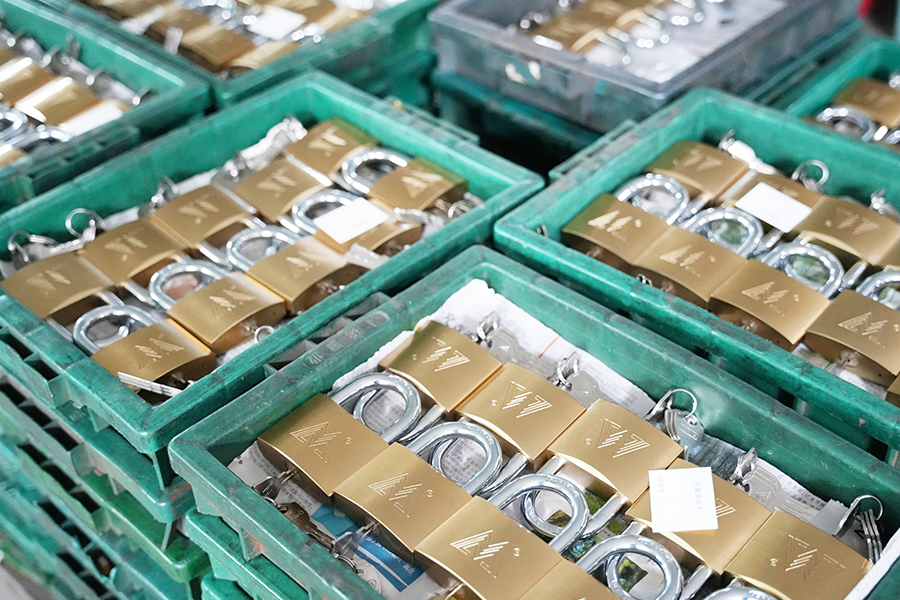
Does a Thicker Coating Always Mean Better Protection?
Coating thickness matters, but simply adding more powder does not guarantee a stronger padlock finish. Industrial coating guidance notes that insufficient film build can leave weak coverage, while excessive thickness can create problems such as brittleness, poor flow, or dimensional issues.
Dry film thickness is normally measured after curing and can be specified in microns or mils. One mil equals approximately 25.4 microns.
Key Coating Factors
- Film thickness: The coating should remain within the powder manufacturer's recommended range.
- Uniform coverage: Thin areas around corners or recesses can become weak points.
- Curing: Proper heat curing helps the powder develop its intended hardness and adhesion.
- Surface preparation: Cleaning and pretreatment have a major influence on coating adhesion and corrosion resistance.
Why Do Edges Matter on an Iron Padlock?
A square or rectangular padlock body contains corners, edges, holes, and recessed areas that can be harder to coat evenly than broad flat surfaces. Research on powder-coated steel has found that surface geometry can influence corrosion behavior, while coating holidays and underfilm corrosion can contribute to coating failure.
This detail matters around the shackle openings and lower body edges of a Powder Coated Iron Door Padlock. A visually attractive exterior does not necessarily indicate uniform protection across every surface.
- Body corners: These areas need adequate powder coverage to reduce exposed metal.
- Shackle openings: Coating should not interfere with the movement or seating of the shackle.
- Keyway area: The cylinder opening needs precise masking or finishing to preserve smooth key operation.
- Bottom surfaces: Hidden areas still require appropriate coating coverage because moisture can collect around them.
Can Powder Coating Improve Outdoor Door Applications?
Outdoor doors, gates, sheds, storage rooms, utility cabinets, and workshops can expose padlocks to rain, humidity, dust, and repeated handling. A powder-coated body can provide an additional surface barrier under these conditions.
Commercial powder-coated padlocks also combine coated metal bodies with hardened steel or boron-alloy shackles. For example, some commercial models use powder-coated aluminum bodies with 6 mm or 10 mm boron-alloy shackles, showing how the body finish and exposed locking component can use different materials for different functions.
The same principle applies to iron-bodied door padlocks: the coating primarily protects the body, while the shackle requires its own corrosion-resistant or hardened material treatment.
What Happens When the Coating Gets Scratched?
Powder coating is not an impenetrable shield. Deep scratches, chips, impact damage, or poorly coated areas can expose the underlying metal. Once the substrate becomes exposed, corrosion can begin at the damaged location and potentially spread beneath the coating.
This is why coating adhesion and pretreatment matter as much as the visible finish. Studies of powder-coated steel identify underfilm corrosion and coating disbondment as significant failure mechanisms.
- Light surface marks: They may affect appearance without immediately exposing the substrate.
- Deep chips: Exposed iron or steel becomes more vulnerable to moisture and corrosion.
- Repeated impact: High-contact areas may experience faster coating wear.
Does the Finish Affect Security?
Powder coating should not be confused with the mechanical security of the padlock. The finish primarily contributes to surface protection, while security depends on the lock body, shackle, cylinder, locking mechanism, and hasp.
That distinction is important. A thick coating cannot compensate for a weak shackle or vulnerable locking system. Likewise, a strong locking mechanism may still require suitable surface protection for outdoor use.
Where Does a Powder-Coated Iron Padlock Make Sense?
- Residential gates: Useful where the lock remains exposed to changing weather.
- Storage doors: The coated body can help protect the iron substrate from humid environments.
- Workshops: Suitable where repeated handling and surface contact are expected.
- Utility cabinets: A durable exterior finish can provide both identification and surface protection.
Final Takeaway
A Powder Coated Iron Door Padlock gains an important functional benefit from its finish: the coating creates a barrier that helps protect the metal body against moisture, corrosion, abrasion, and everyday environmental exposure.
Still, the coating is only as effective as the complete finishing process. Proper pretreatment, suitable film thickness, uniform coverage, controlled curing, and good edge protection all contribute to performance. Buyers evaluating a powder-coated padlock should therefore look beyond color and appearance and examine the coating specification together with the body, shackle, cylinder, and locking mechanism.
Powder-Coated Door Padlocks: Does Finish Add Protection
High Security Padlock Factory
Copyright © Zhejiang Pujang Wushi Locks Co., Ltd. All Rights Reserved.
